Table of Contents
- What Is AGI? A Clear, No-Fluff Definition
- What Is AI? Understanding Narrow AI vs General AI
- Difference Between AI and AGI: Side-by-Side Comparison
- How Close Are We to AGI? What the 2026 Data Actually Shows
- AGI Timeline 2026: What Experts Are Actually Saying
- AGI Risks and AGI Safety: Why This Isn’t Just a Technical Question
- Common Mistakes People Make When Talking About AGI
- How Businesses Should Actually Think About This
- Expert Tip
- Key Takeaways
- Conclusion
How Close Are We to AGI in 2026? What the Data Actually Shows (Not Just AI Hype)
Every few months, someone declares that AGI has arrived, or that it’s still decades away. Both can’t be right, and honestly, neither claim is usually backed by much evidence.
The truth sits somewhere less dramatic and more useful: in 2026, we have real data — revenue numbers, benchmark scores, and capability trends — that tell us exactly how far AI has come and where it’s still stuck. Understanding AGI vs AI isn’t just an academic exercise anymore. It’s becoming relevant to how businesses plan, hire, and invest over the next few years.
This guide breaks down what AGI actually means, how it differs from the AI tools you already use, and what the latest verified data says about how close we really are. No hype, no doom — just what the evidence supports.
What Is AGI? A Clear, No-Fluff Definition
AGI (artificial general intelligence) refers to an AI system that can understand, learn, and perform a wide range of cognitive tasks at or above human level, without needing to be specifically trained for each one. Unlike today’s AI, which is built to excel at narrow, specific jobs, AGI would be able to adapt across domains the way a capable human professional can.
OpenAI, one of the organizations racing toward this goal, defines AGI in its own mission statement as “highly autonomous systems that outperform humans at most economically valuable work.” That definition matters because it’s not about AI being clever in a lab demo — it’s about AI being able to do real jobs, across real industries, better than the people currently doing them.
Even Sam Altman has acknowledged that the term AGI has become, in his words, a bit of a moving target — different people mean different things by it, and the definition tends to shift as capabilities improve. That ambiguity is actually one of the more honest things anyone in the industry has said about it.
Is ChatGPT AGI?
No. ChatGPT and similar tools like Claude and Gemini are advanced language models, not AGI. They’re extremely capable at specific tasks — writing, coding, analysis — but they don’t yet operate with the autonomous, cross-domain adaptability that defines true general intelligence. They also can’t reliably learn new skills on the fly the way a human employee would after being shown something once.
What Is AI? Understanding Narrow AI vs General AI
AI (artificial intelligence), in its current form, is what’s often called “narrow AI” — systems built and trained to do specific tasks well. A model trained to write code doesn’t automatically know how to manage a warehouse. A model that generates images can’t diagnose a medical condition unless it’s separately trained for that.
This is the core distinction in the narrow AI vs general AI debate: narrow AI is a specialist. General AI, if achieved, would be a generalist — closer to how a human can learn a completely new job by applying existing knowledge and reasoning.
Today’s AI tools already handle a wide range of tasks:
- Writing and summarizing content
- Coding and debugging software
- Analyzing data and spotting patterns
- Customer service and chat support
- Image and video generation
- Voice assistants and translation
But each of these usually requires a model that’s been specifically trained or fine-tuned for that job. Stitch several together with an “agent” framework, and it looks more general — but it’s still task orchestration, not genuine general reasoning.
Difference Between AI and AGI: Side-by-Side Comparison
| Factor | AI (Narrow AI) | AGI (Artificial General Intelligence) |
| Scope | Task-specific | Cross-domain, human-like adaptability |
| Learning | Requires training per task | Learns and adapts across new tasks |
| Autonomy | Needs human oversight and prompts | Operates independently on open-ended goals |
| Current status | Widely deployed today | Not yet achieved |
| Examples | ChatGPT, Claude, image generators, recommendation engines | Theoretical; no confirmed system exists |
| Real-world reliability | Strong on structured, well-defined tasks | Would need to match humans on messy, unstructured tasks too |
This table gets at the heart of why the AGI vs AI conversation matters for businesses right now. You’re already using narrow AI, probably every day. AGI is a different, much bigger claim — one that hasn’t been met yet, no matter how impressive current tools seem.
How Close Are We to AGI? What the 2026 Data Actually Shows
Here’s the direct answer: based on verified benchmarks and revenue data from 2026, AI capabilities are advancing faster than most forecasters expected a year ago — but AGI, in the full sense of matching human generality across messy real-world tasks, has not been achieved. Expert timelines have shortened, not confirmed.
Let’s look at the actual evidence, rather than opinions.
AI Revenue Growth Is Historic — But It’s Not Proof of AGI
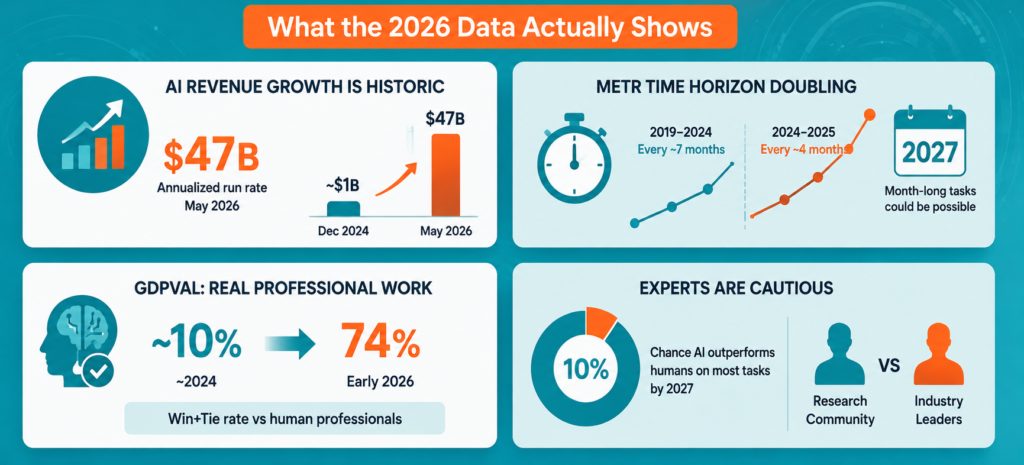
Anthropic‘s annualized revenue run rate reached $47 billion in May 2026, up from roughly $1 billion in December 2024 — one of the fastest revenue scaling trajectories ever recorded for an enterprise software company. That kind of growth tells you businesses are getting real, paid value from current AI tools. It does not, by itself, tell you AGI has arrived. Revenue growth measures commercial usefulness, not general intelligence.
METR’s Time Horizon Data: A Genuinely Useful Signal
One of the more rigorous ways researchers are tracking AI progress is METR’s “time horizon” benchmark, which measures how long a task would take a human expert to complete, matched against tasks AI models can now complete with 50% reliability.
From 2019 to around 2024, this time horizon doubled roughly every seven months. Since then, that pace has accelerated — with some analyses showing a doubling time closer to four months over 2024–2025. If that faster trend held, AI systems could be capable of month-long autonomous tasks sometime in 2027, though researchers are careful to note this is based on a shorter, less certain dataset.
This matters because it’s one of the few concrete, repeatable ways to measure whether AI is generalizing to longer, more complex work — a key marker on the road toward AGI, even if it’s not AGI itself.
GDPval: Testing AI Against Real Professional Work
OpenAI’s GDPval benchmark is worth paying attention to because it tests AI models against 1,320 real-world tasks across 44 occupations — legal briefs, financial analysis, nursing care plans, engineering blueprints — created and graded by professionals with an average of 14 years of experience.
The results are genuinely striking: OpenAI’s models improved their win rate against human experts from roughly 10% to 35% in about a year, and by early 2026, top models were scoring around a 74% win-plus-tie rate against human professionals on this benchmark.
That’s a real signal that AI is closing the gap on well-defined, digital knowledge work. But researchers at Epoch AI, who track these benchmarks closely, caution that high GDPval scores don’t imply full automation of entire professions — the tasks tested are still relatively self-contained, not the messy, open-ended judgment calls that make up most real jobs.
Expert Opinion Is Split — and Getting More Cautious About Certainty
In one of the largest surveys of AI researchers to date, involving over 2,700 participants, researchers collectively estimated only a 10% chance that AI systems could outperform humans on most tasks by 2027. That’s a meaningfully more conservative number than some of the public statements coming from AI company leadership.
Meanwhile, some industry leaders have offered far more aggressive predictions — both Elon Musk and Anthropic CEO Dario Amodei have suggested AI could outsmart humans as soon as 2026, though these are individual forecasts, not consensus positions.
This split matters. When you see confident public statements about AGI “arriving soon,” it helps to know that the broader research community is generally far less certain.
AGI Timeline 2026: What Experts Are Actually Saying
There’s no single agreed AGI timeline — that’s part of the problem with the term itself. But here’s a reasonable summary of where credible voices land as of 2026:
- OpenAI’s public position has shifted over time, with Sam Altman suggesting somewhere in the 2026–2032 range, depending on which definition of AGI you use, and even framing recent progress as a “gentle singularity” rather than a sudden leap.
- Independent researcher surveys put meaningfully lower odds (around 10%) on AI outperforming humans on most tasks by 2027.
- Capability benchmarks like METR and GDPval show consistent, measurable acceleration in specific domains — especially coding and structured knowledge work — without yet showing similar gains in messy, unstructured, real-world business judgment.
The honest takeaway: AGI timelines have compressed compared to a year or two ago, largely because narrow capability jumps (like coding agents) surprised even experienced researchers. But “sooner than expected” is not the same as “confirmed” or “imminent.”
AGI Risks and AGI Safety: Why This Isn’t Just a Technical Question
Even without AGI being achieved, the pace of current AI progress has raised real safety and governance questions that business leaders should be aware of:
- Autonomous AI agents are increasingly capable of taking multi-step actions with less human oversight, which raises questions about accountability when something goes wrong.
- AI existential risk discussions, once fringe, are now raised by mainstream figures — including AI company leadership itself — as a reason for coordinated safety research rather than pure competition.
- AI regulation conversations are accelerating globally, with governments trying to catch up to capability growth that’s outpacing most existing policy frameworks.
None of this requires AGI to already exist. Narrow AI systems that are highly capable but not fully general can still cause meaningful real-world impact — good and bad — well before anything resembling AGI shows up.
Common Mistakes People Make When Talking About AGI
Mistake 1: Treating any impressive AI demo as proof of AGI. A chatbot writing a great essay or an agent completing a coding task is impressive — but it’s not evidence of general, cross-domain intelligence.
Mistake 2: Ignoring the difference between narrow benchmark performance and real-world reliability. High scores on structured tests like GDPval don’t automatically translate to dependable performance on the messy, judgment-heavy work most businesses actually run on.
Mistake 3: Assuming AGI timelines are settled science. They’re forecasts, often from people with a financial or reputational interest in being right about timing. Treat public AGI predictions the way you’d treat any other forecast: useful context, not certainty.
Mistake 4: Confusing revenue growth with capability breakthroughs. Strong commercial adoption of AI tools (like Anthropic’s revenue trajectory) reflects real usefulness today — not confirmation that general intelligence has been reached.
How Businesses Should Actually Think About This
You don’t need AGI to arrive for AI to matter for your business right now. Here’s what’s actually useful to focus on:
- Track capability trends, not headlines. Benchmarks like METR’s time horizons and GDPval are far more reliable indicators than any single company’s marketing claims.
- Separate “AI is useful today” from “AGI has arrived.” These are different claims with different implications for planning.
- Watch for AI’s growing role in how people search and get information. Regardless of AGI timelines, AI-powered search and answer engines are already reshaping how customers discover businesses — which is where strategies like Answer Engine Optimization and Generative Engine Optimization become genuinely important today, not hypothetically.
- Build with current AI capabilities, not future promises. Automation, local search visibility, and AI-readable content all deliver value now, independent of when or whether AGI eventually arrives.
Expert Tip
If you want a quick gut-check on any AGI claim you come across, ask: is this based on a specific, named benchmark or dataset, or is it a general statement about “the pace of progress”? Claims tied to something like METR’s time horizons or OpenAI’s GDPval are far more grounded than vague predictions about AGI being “just around the corner.”
Key Takeaways
- AGI is a theoretical system with human-level, general adaptability across tasks. It has not been achieved as of 2026.
- AI (narrow AI) is task-specific and already widely deployed — including the tools most businesses use daily.
- The difference between AI and AGI comes down to autonomy, adaptability, and generality, not just raw capability.
- ChatGPT and similar models are not AGI, even though they’re highly capable at specific tasks.
- Verified 2026 data — including METR’s accelerating time-horizon trend and OpenAI’s GDPval results — shows real capability gains, especially in structured, digital knowledge work.
- Researcher surveys suggest more caution than some public industry predictions, with only a 10% estimated chance AI outperforms humans on most tasks by 2027.
- AGI risks and AGI safety are worth taking seriously now, independent of whether or when full AGI arrives.
- Businesses don’t need to wait for AGI to benefit from AI — the practical opportunity is already here.
Conclusion
The AGI vs AI conversation gets muddier every time a new capability jump goes viral. But when you strip away the hype and look at what’s actually been verified — revenue data, benchmark scores, researcher surveys — the picture is more measured than most headlines suggest. AI is advancing fast, faster than many expected even a year ago. AGI, in the full sense of the term, hasn’t arrived, and reasonable experts still disagree meaningfully about when — or whether — it will.
What’s clear is this: the businesses paying attention to how AI is already reshaping search, automation, and customer behavior today are the ones positioning themselves well, regardless of how the AGI timeline plays out.
Curious how these AI shifts are already affecting how customers find and choose businesses like yours? Book a free business growth consultation with Minchow Coders, and we’ll walk you through where your visibility stands today, across Google, AI search, and beyond.
More insights
AI Agents in 2026: What They Are, How They Work, and How Businesses Can Use Them
A chatbot can answer a customer’s question. An automation can move information from one application to another. An AI…
GPT-6 Astra AGI: Is This OpenAI’s AGI Era Moment
OpenAI did something no major AI lab had done before in such blunt terms: it stood in front of…

The Lean Startup Summary: The Complete Breakdown Every Founder Needs
The Lean Startup by Eric Ries teaches entrepreneurs to test business ideas with a Minimum Viable Product instead of writing a long business plan. The lean startup methodology uses a Build-Measure-Learn loop to validate what customers actually want, so founders…
Want results like this for your business?
Book a free consultation and we will show you where to start.
Talk to us on WhatsApp