Table of Contents
- What Is The Lean Startup Book About
- About the Author: Eric Ries
- Core Ideas Explained: The 5 Principles Behind the Lean Startup Methodology
- Chapter-Wise Summary: Vision, Steer, Accelerate
- Key Lessons From The Lean Startup
- Actionable Takeaways You Can Apply This Week
- Who Should Read The Lean Startup?
- Limitations and Criticism of the Lean Startup Methodology
- Final Verdict: Is The Lean Startup Worth Reading?
- Book a Free Growth Consultation
The Lean Startup Summary: The Complete Breakdown Every Founder Needs
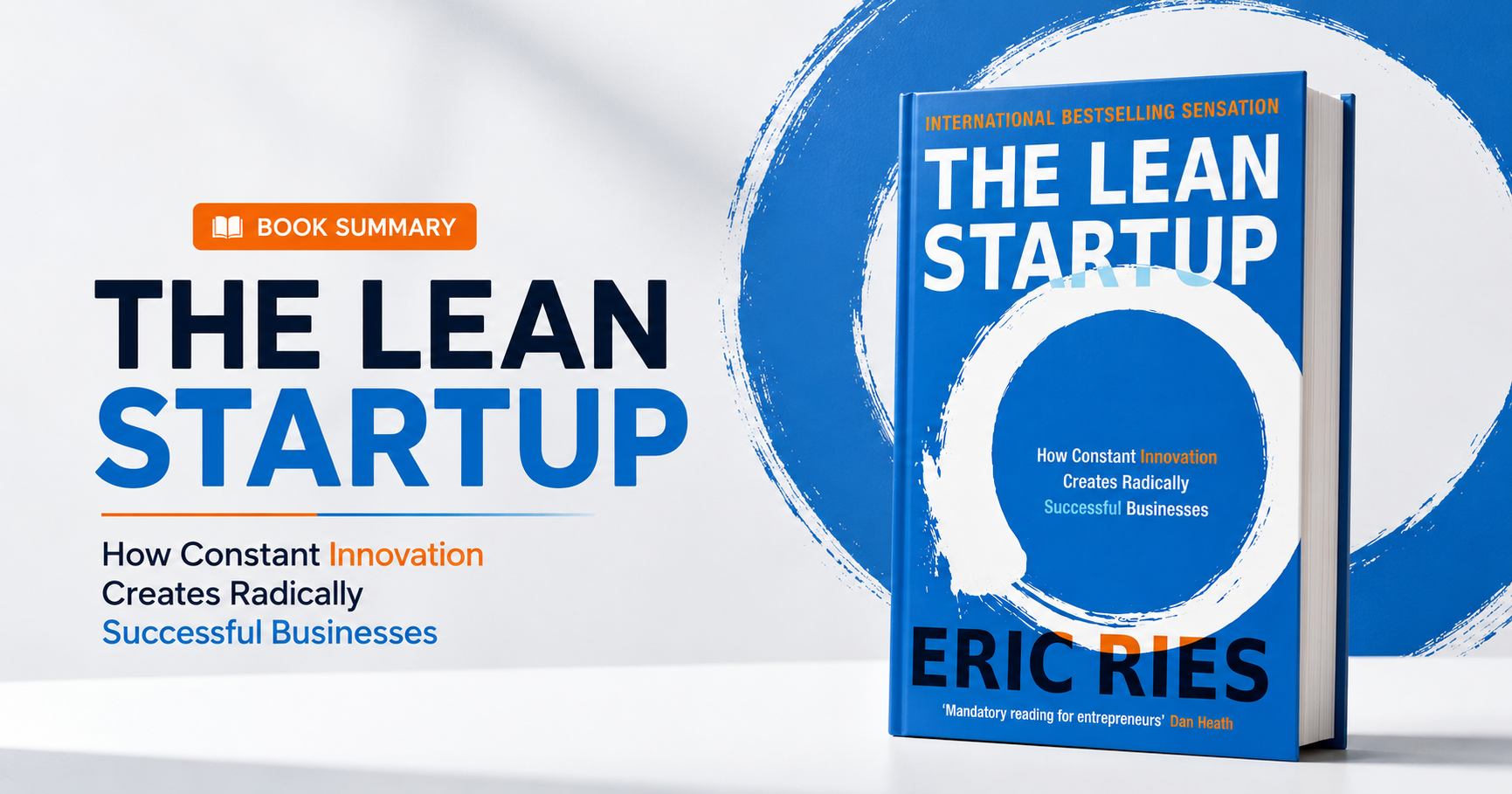
The Lean Startup by Eric Ries teaches entrepreneurs to test business ideas with a Minimum Viable Product instead of writing a long business plan. The lean startup methodology uses a Build-Measure-Learn loop to validate what customers actually want, so founders waste less time and money before deciding whether to pivot or keep going.
Most business owners start with an idea they believe in. Then they spend months building it before they ever show it to a real customer. By the time they find out nobody wants it, the money and time are already gone.
That’s the exact problem Eric Ries set out to fix with the lean startup approach. And it’s why this book still gets recommended more than a decade after it was first published.
This summary breaks down every core idea from the book, explains what each concept means in plain English, and shows how the lean startup methodology applies to real businesses today, not just Silicon Valley tech companies.
What Is The Lean Startup Book About
The Lean Startup: How Today’s Entrepreneurs Use Continuous Innovation to Create Radically Successful Businesses was written by Eric Ries and first published in 2011.
The book argues that building a company under uncertainty needs a different kind of management than running an established business. Ries calls this entrepreneurial management, and it treats every new product idea as a hypothesis to be tested, not a plan to be executed.
The lean startup framework borrows heavily from lean manufacturing, the system Toyota made famous. Ideas like small batch sizes, reducing waste, and fast feedback loops get applied to building products and companies instead of cars.
Why does this book matter? Because most new products fail for a predictable reason: they solve a problem nobody cares enough about to pay for. The lean startup methodology gives founders a repeatable process to find that out early, before it becomes expensive.
About the Author: Eric Ries
Eric Ries is an American entrepreneur and the co-founder of IMVU, an online social platform. His experience building IMVU under intense uncertainty is where many of the book’s core ideas came from.
Ries later served as an entrepreneur-in-residence at Harvard Business School and became a well-known advisor to startups and larger companies trying to innovate more effectively. His work has been covered by major business publications, and the lean startup methodology has influenced how thousands of companies approach product development.
Note on sourcing: Different editions may organize this content differently. The ideas below are based on the core concepts presented throughout the book and cross-checked against multiple established public summaries.
Core Ideas Explained: The 5 Principles Behind the Lean Startup Methodology
Ries builds his entire framework around five principles. Understanding these first makes the rest of the lean startup methodology much easier to apply.
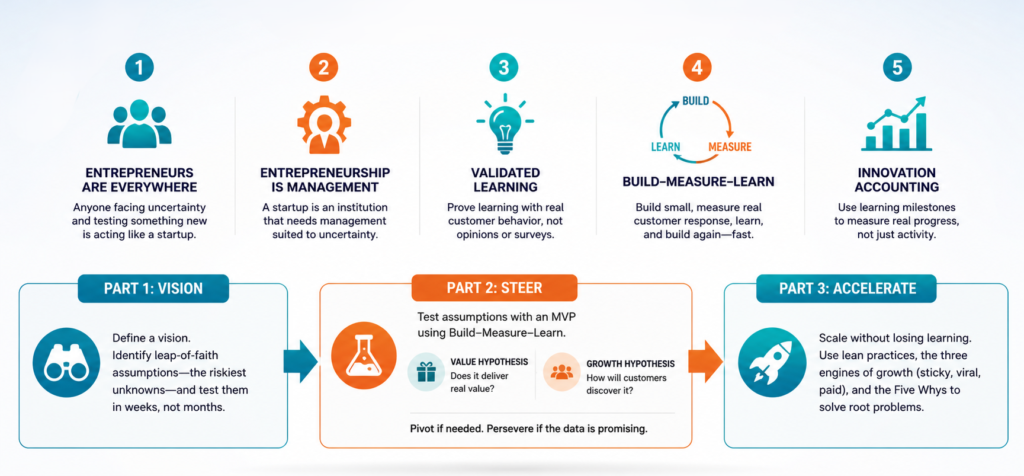
1. Entrepreneurs Are Everywhere
A startup, according to Ries, is “a human institution designed to create a new product or service under conditions of extreme uncertainty.” That definition has nothing to do with garage offices or venture capital.
A marketing manager testing a new campaign format under uncertainty is acting like a startup founder. So is a local business owner trying a service they’ve never offered before. If you don’t know how customers will respond, you’re operating under the same conditions this book was written for.
2. Entrepreneurship Is Management
People often treat entrepreneurship as instinct and management as structure. Ries rejects that split. A startup is an institution, and institutions need management, just a different kind suited to uncertainty instead of routine.
3. Validated Learning
Learning feels unproductive compared to shipping features or closing sales. But Ries argues that learning what customers actually want is the real output of early-stage work. Validated learning means proving that learning with real customer behavior, not opinions or surveys.
4. Build-Measure-Learn
This is the engine of the entire lean startup methodology. You build something small, measure how real customers respond, and learn from that data. Then you decide what to build next. The goal is to move through this loop as fast as possible, because speed of learning is a genuine competitive advantage.
5. Innovation Accounting
Traditional accounting doesn’t work for a business that has no sales history yet. Innovation accounting gives founders a way to set learning milestones and measure real progress, instead of celebrating activity that doesn’t move the business forward.
Chapter-Wise Summary: Vision, Steer, Accelerate
The book is organized into three parts. Here’s what each one covers.
Part One: Vision
This section makes the case for entrepreneurial management and introduces validated learning as the real measure of progress. Ries explains that every startup starts with a vision, achieves it through a strategy, and expresses that strategy through a product.
The key idea here is to identify your “leap-of-faith assumptions.” These are the riskiest parts of your plan, the things you’re betting everything on without proof. Instead of building a full product around those assumptions, you test them in a matter of weeks.
Part Two: Steer
Once you’ve identified your leap-of-faith assumptions, you test them using a Minimum Viable Product, or MVP. This is the smallest version of your product that lets you complete one full turn of the Build-Measure-Learn loop.
Ries breaks this down into two hypotheses every founder needs to test:
- Value hypothesis: Does the product actually deliver value once customers use it?
- Growth hypothesis: How will new customers discover the product?
A well-known example from the book is Zappos. Instead of building a warehouse full of shoes, founder Nick Swinmurn photographed shoes from local stores and posted them online. When people tried to buy, he bought the shoes at retail price to fulfill the order. That simple test proved people would buy shoes online, without the cost of building real infrastructure first.
This section also introduces the pivot-or-persevere decision. If your data shows the hypothesis is wrong, you pivot, a structured change in strategy based on what you learned. If the data is promising, you persevere and keep refining.
Part Three: Accelerate
Once a company has found a working product and customer base, this section explains how to grow without losing the discipline that got you there.
Ries applies lean manufacturing concepts like small batch sizes and continuous deployment to product development, so teams can keep learning quickly even as they scale. He also covers the three engines of growth (sticky, viral, and paid) and introduces the “Five Whys,” a method for tracing root causes of problems instead of applying quick fixes that don’t stick.
Key Lessons From The Lean Startup
- A business plan built on untested assumptions is a guess dressed up as a strategy.
- Customers reveal what they want through their actions, not through what they say in a survey.
- Speed of learning matters more than speed of building.
- Vanity metrics like website visits or social followers can make a failing business feel successful.
- A pivot isn’t a failure. It’s a decision based on evidence, and it often leads to the eventual success story.
Actionable Takeaways You Can Apply This Week
- Write down your riskiest assumption. Before building anything new, name the one thing you’re betting on that you haven’t actually proven.
- Build the smallest possible test. Ask what the cheapest, fastest way is to get real customer behavior data on that assumption.
- Pick one metric that matters. Choose something actionable, not a vanity number that looks good but doesn’t tell you anything useful.
- Set a pivot checkpoint. Decide in advance when you’ll review the data and honestly ask whether to change direction.
- Talk to real customers, not your team. Internal opinions about what customers want are not a substitute for actual customer behavior.
At Minchow Coders, we see business owners apply this exact thinking to marketing decisions every day, even outside the startup world. Before rolling out a new campaign or service across every location, testing it small first and measuring real results avoids wasting budget on something that looked good in theory.
Who Should Read The Lean Startup?
This book was written with startup founders in mind, but the ideas apply much further.
- Startup founders building a product with no proven demand yet.
- Small business owners and local business owners testing a new service, offer, or location before committing fully.
- Marketing managers who want a smarter way to test campaigns before spending the full budget.
- Agency owners managing multiple clients who each face their own version of “we don’t know what will work yet.”
- Multi-location business owners deciding whether a new idea should be tested in one location before rolling it out everywhere.
If your job involves making decisions with incomplete information, and most business decisions fall into that category, the lean startup methodology gives you a practical way to reduce that risk.
Limitations and Criticism of the Lean Startup Methodology
No framework works perfectly in every situation, and this one has known limitations worth understanding honestly.
Some critics point out that the Minimum Viable Product approach is harder to apply in industries with high regulatory requirements, heavy upfront hardware costs, or safety-critical products, where you can’t simply launch something small and iterate.
Others note that “validated learning” can be misapplied if teams aren’t disciplined about choosing real metrics. It’s possible to run experiments that feel scientific while still tracking numbers that don’t actually predict business success.
There’s also a broader critique that treating every decision as an experiment can slow down calls that don’t need formal testing, adding process where judgment would work just as well.
Final Verdict: Is The Lean Startup Worth Reading?
The lean startup methodology holds up well over a decade after publication, not because every tactic still applies exactly as written, but because the underlying discipline does. Testing assumptions before committing resources is good advice in almost any business, not just tech startups.
The book is genuinely worth reading in full. This summary covers the core lean startup framework, but Ries includes detailed case studies, deeper explanations of innovation accounting, and nuance around each type of pivot that are worth your time if you’re serious about applying this in your own business.
Read the original book here: The Lean Startup by Eric Ries
Book a Free Growth Consultation
If you’re a local business owner or marketing manager thinking about testing a new offer, service, or location before committing your full budget to it, that’s exactly the kind of decision Minchow Coders helps clients think through, using the same evidence-first approach this book describes, applied to local SEO and AI search visibility.
Book a free business growth consultation with Minchow Coders to talk through your next move before you spend the budget on it.
More insights

AI Agents in 2026: What They Are, How They Work, and How Businesses Can Use Them
A chatbot can answer a customer’s question. An automation can move information from one application to another. An AI…

GPT-6 Astra AGI: Is This OpenAI’s AGI Era Moment
OpenAI did something no major AI lab had done before in such blunt terms: it stood in front of…

n8n AI Automation 2026: What the Latest Update Means for Business Automation
Somewhere in your business right now, someone is copying data from one spreadsheet to another by hand. Or forwarding…
Want results like this for your business?
Book a free consultation and we will show you where to start.
Talk to us on WhatsApp