Table of Contents
- What Is AI Citation Content Refresh
- How Often Should You Update Content for AI Citations
- Content Refresh Frequency by Type
- A Realistic Example: How This Plays Out for a Local Service Business
- Which Signals Should Trigger an Immediate Update
- What Actually Moves the Needle: The Citation-Ready Refresh Checklist
- Common Mistakes Businesses Make With Content Refreshes
- Best Practices for a Sustainable Refresh Program
- Why This Becomes a Bandwidth Problem Fast
- Key Takeaways
- Conclusion
- CTA
AI Citation Content Refresh: How Often Should You Update Content to Get Cited by AI
You publish a blog post. It ranks. Six months go by, and you notice something strange. ChatGPT recommends your competitor by name. Google’s AI Overview quotes a company you’ve never even heard of. Your own page, the one that used to bring in steady traffic, barely shows up anywhere.
Nothing about your content got worse. It just got older, and in the world of AI search, old and irrelevant have started to look a lot alike.
This is the reality behind AI citation content refresh: a deliberate, ongoing process of updating existing pages so they keep earning mentions inside ChatGPT, Perplexity, Google AI Overviews, and Gemini. The question every marketer keeps asking is simple. How often does this actually need to happen? The answer, once you look at the data, is more specific than most advice out there suggests.
This guide walks through what the research actually shows, how often different content types need attention, and what to do when your team doesn’t have the bandwidth to keep up with it.
What Is AI Citation Content Refresh
AI citation content refresh is the practice of updating existing web pages, with new statistics, restructured sections, and current examples, so AI search engines keep selecting them as sources. It’s different from a standard SEO refresh because the goal isn’t just a higher ranking. It’s getting your business named directly inside an AI-generated answer.
Traditional SEO refreshes focus on keywords and backlinks. AI citation content refresh focuses on something else entirely: extractability. Can an AI model pull a clean, factual answer out of your page without confusion? Does your content read like something worth quoting?
This distinction matters because a page can rank on page one of Google and still get skipped entirely by ChatGPT. The two systems don’t always agree on what counts as a good source.
How Often Should You Update Content for AI Citations
Most high-value content should be reviewed monthly and substantively updated every 3 to 6 months, though the exact frequency depends on content type. Product pages and fast-moving topics need monthly attention. Evergreen guides can go 6 to 12 months between refreshes. What matters more than the calendar date is whether specific citation signals have dropped.
Here’s where the industry conversation gets interesting. Two schools of thought exist, and both are backed by real data.
The freshness camp points to measurable patterns. According to Ahrefs’ analysis of citations across AI platforms, content cited by AI tends to be noticeably newer than content that ranks well organically, and ChatGPT in particular shows a strong pull toward pages updated within the past year. Separate research reported by AirOps found that a large majority of pages earning AI citations for commercial queries had been updated within the last 12 months, and more than half within the last 6 months.
The structure camp argues frequency alone won’t save a poorly built page. A widely cited meta-analysis of dozens of AI citation studies, compiled by SEO researcher Cyrus Shepard, ranked the factors that most reliably predict whether a source gets cited. URL accessibility and search ranking topped the list. Content recency didn’t crack the top five.
Both camps are right, just about different things. Freshness increases your odds of being considered. Structure determines whether you actually get picked once you’re in the running. A monthly refresh on a badly organized page wastes effort. A perfectly structured page that hasn’t been touched in two years eventually falls behind on facts, even if its format still works.
Content Refresh Frequency by Type
Not every page needs the same attention. Here’s a practical breakdown based on how fast each content type tends to lose relevance.
| Content Type | Recommended Refresh Cadence | Why |
| Service or product pages | Monthly | High competition for citations, pricing and offer details change often |
| Data-heavy guides and statistics posts | Every 3 months | Numbers age quickly; outdated stats hurt credibility fast |
| Evergreen educational blog posts | Every 6 months | Core concepts stay stable, but examples and context need updating |
| Comprehensive pillar content | Annually, with monthly monitoring | Large investment pages benefit from a full structural review once a year |
| Local business FAQ pages | Every 6 to 12 months | Should reflect current hours, services, and location details |
Industry speed matters too. A marketing agency covering AI search trends will need to refresh faster than a plumbing company writing about drain maintenance, simply because the underlying facts change at different rates.
It helps to think about this in terms of how fast the underlying facts change, not how important the page feels to you. A law firm’s page explaining a specific state regulation needs updating the moment that regulation changes, regardless of when it was last touched. A dental clinic’s page about general oral hygiene tips can sit untouched for a year without losing much value, because the core advice hasn’t changed. Sorting your content library into “fact-sensitive” and “advice-stable” categories first makes the refresh schedule above much easier to apply in practice.
A Realistic Example: How This Plays Out for a Local Service Business
Picture an HVAC company with a blog post titled “How Much Does AC Repair Cost?” published two years ago. For the first year, it performed well. It ranked on page one, brought in steady form submissions, and occasionally showed up when people asked ChatGPT about repair pricing in their area.
Then the numbers started aging. Repair costs had shifted. A competitor published a more detailed breakdown with a comparison table and a clear FAQ section. Within a few months, that competitor’s page started showing up in AI Overviews instead, and the HVAC company’s citations quietly disappeared.
Nothing about the original page was broken. It just stopped being the most current, most extractable answer available. A one-hour refresh, updating the pricing figures, adding a comparison table by repair type, and including a short FAQ block, was enough to bring the page back into contention within a few weeks of monitoring.
This is a common pattern. The page doesn’t need to be rebuilt from scratch. It needs the specific gap closed that let a competitor take its place.
Which Signals Should Trigger an Immediate Update
Update a page right away if it loses a citation it previously held, drops out of the top 10 organic results for its target query, or a competitor publishes a more structured piece on the same topic. Waiting for a scheduled refresh date can mean losing citation share you won’t easily win back.
These triggers matter more than any fixed calendar:
- A page that was previously cited in AI Overviews or ChatGPT stops appearing for the same queries
- Organic ranking drops below position 10 for the primary keyword
- A competitor publishes new content with better structure or more current data on the same topic
- The page contains a statistic, price, or claim that’s now out of date
- Your product, service, or offer has changed since the page was published
Monitoring for these signals matters more than sticking to a rigid schedule. A page that’s still earning citations doesn’t need a rewrite just because a date on the calendar arrived.
What Actually Moves the Needle: The Citation-Ready Refresh Checklist
An effective content refresh updates statistics, restructures content into short answerable sections, adds FAQ blocks, and strengthens author credibility signals. Simply changing a published date without touching the substance of the page does not improve citation rates.
Practitioner data shared in SEO communities shows a clear pattern. Teams that applied a structured five-part refresh approach across a large batch of pages, updating statistics, tightening structure, adding FAQ sections, and strengthening author credentials, saw citation rates roughly quadruple compared to their starting point. One individual page reportedly went from earning almost no AI citations to appearing in most tested queries after a focused, same-day update.
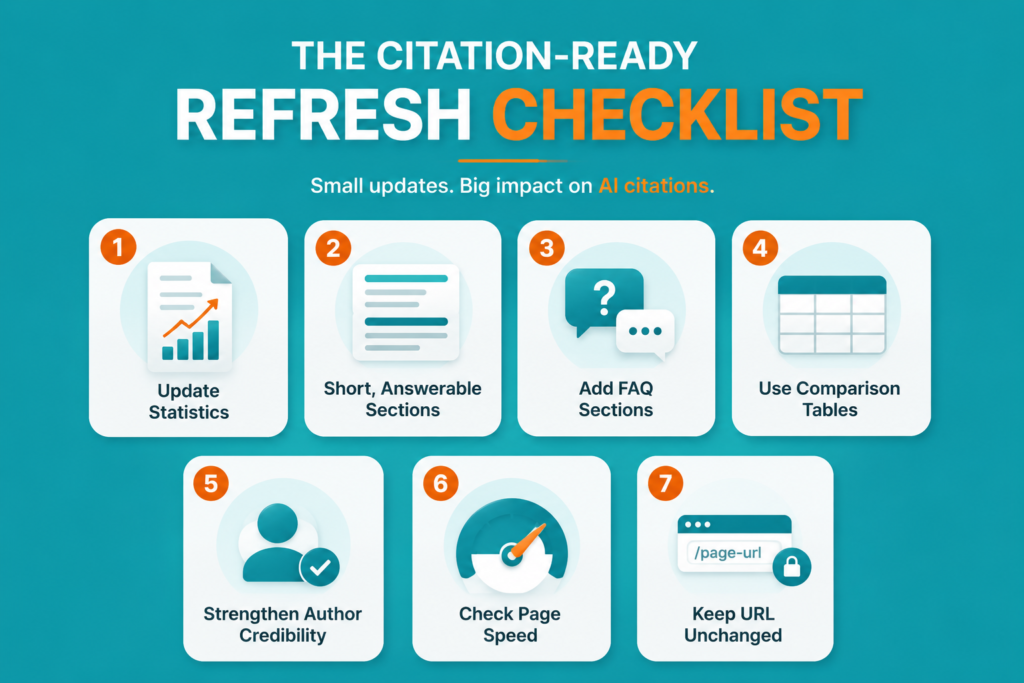
Here’s the checklist that produces results:
- Replace outdated statistics. Swap old numbers for current-year data. Aim for a handful of fresh statistics per page rather than leaving decade-old figures in place.
- Break long paragraphs into short, answerable sections. AI models extract information more easily from concise blocks than from dense, multi-idea paragraphs.
- Add FAQ sections that mirror real questions. People ask AI tools questions the same way they’d ask a colleague. Structure content to match.
- Include comparison tables where relevant. Tables are some of the easiest formats for AI systems to pull clean information from.
- Strengthen author or business credibility. A clear statement of experience and expertise, tied to a real name or business, has been linked to noticeably higher citation rates in tested cases.
- Check page load speed. Slower pages are less likely to be crawled and cited frequently.
- Keep the URL unchanged. Changing a URL during a refresh resets the trust signals the page has already built.
Common Mistakes Businesses Make With Content Refreshes
- Changing only the publish date. AI models can compare a page against earlier cached versions. A cosmetic date change without real content updates doesn’t fool the system and doesn’t help citation rates.
- Refreshing on a fixed schedule regardless of performance. A page that’s still earning citations doesn’t need a rewrite just because three months have passed.
- Adding more words without adding more structure. Longer content isn’t automatically better content. Structure and clarity matter more than word count.
- Ignoring Perplexity and ChatGPT because Google still sends traffic. Different AI platforms pull from different sources. Optimizing for Google alone leaves citation opportunities on the table with other engines.
- Treating this as a one-time project. A single refresh produces a temporary lift. Ongoing content freshness signal maintenance is what sustains it.
Best Practices for a Sustainable Refresh Program
Start with your highest-traffic and highest-conversion pages, not your entire content library at once. Trying to refresh everything in month one is how most refresh programs stall out. Pick the 10 to 20 pages that already drive the most business value and start there. Once that rotation feels manageable, expand it.
Run a small pilot before committing to a full-scale program. Choose 10 to 15 pages across a few different content types, apply the checklist above, and give it 30 days. This gives you real evidence of what’s working before you invest in refreshing hundreds of pages.
Track citation appearances manually before assuming a tool will do it for you. Test the same set of queries across ChatGPT, Perplexity, and Google AI Overviews before and after each refresh, and keep a simple log. It’s tedious at first, but it tells you which specific changes actually moved the needle for your content.
Build a simple content calendar that treats refresh work as its own line item. When refresh work isn’t scheduled, it always loses to the pressure of publishing something new. Blocking dedicated time for it, even a few hours a week, keeps older pages from quietly losing ground.
Separate “monitoring” from “updating.” Check performance often, ideally weekly for your top pages. Only rewrite when a real signal calls for it. This alone prevents wasted effort on pages that are still performing well.
Keep a record of what changed and when. Even a simple spreadsheet noting the date, the changes made, and the citation status before and after builds a body of evidence over time. That record makes it much easier to decide which types of updates are actually worth repeating.
Expert Tip
Most teams treat content refresh as an occasional cleanup task instead of an ongoing editorial cycle. That’s the real gap. A business publishing four new posts a week but never touching last year’s content is likely losing citation ground on its own back catalog while focusing entirely on new output. The strongest AI search content update frequency strategy usually isn’t about publishing more. It’s about maintaining what already exists while it still has ranking and citation equity to protect.
Why This Becomes a Bandwidth Problem Fast
Here’s the part most guides skip. A content library of 50 pages, refreshed on a reasonable monthly and quarterly rotation, adds up to real hours every single month. For a marketing agency managing content across five or ten client accounts at once, that workload multiplies quickly.
This is exactly where content refresh strategy for AEO starts to break down in practice. Teams either fall behind on refreshes, or new content production stalls because everyone is busy updating old pages instead of researching new topics.
A white label content writing service solves this specific problem. Instead of hiring and training an in-house content team, an agency can outsource content writing for agencies to a partner who handles both new articles and scheduled refreshes, delivered under the agency’s own brand. The agency keeps the client relationship. The refresh cycle keeps running. Nobody on the client side needs to know the writing happened somewhere else.
For agencies specifically, this isn’t just about saving time. It’s about being able to promise clients a consistent AI citation content refresh cadence without needing to build an entire editorial department to deliver on that promise.
Key Takeaways
- AI citation content refresh means updating existing pages so AI search engines keep citing them, not just updating them for traditional ranking purposes.
- Content recency correlates with AI citations, but structure and factual accuracy matter just as much, if not more.
- Refresh frequency should vary by content type: monthly for product pages, quarterly for data-heavy guides, every 6 to 12 months for evergreen content.
- Watch for citation drops, ranking declines, or competitor activity as triggers for an update, rather than relying only on a fixed schedule.
- Cosmetic changes like a new publish date don’t work. Substantive updates to statistics, structure, and credibility signals do.
- Agencies managing multiple clients often hit a bandwidth wall with refresh work, which is where a white label content writing service becomes practical rather than optional.
Conclusion
There isn’t a single magic number for how often to update content for AI citations. What the data does show is a pattern: pages that combine reasonable freshness with strong structure consistently outperform pages that rely on just one or the other.
Start by watching your existing content for real signals. A dropped citation, a ranking slip, a competitor’s better-structured page. Update when those signals appear, and build a realistic cadence around your highest-value pages first. Trying to refresh everything at once usually means refreshing nothing well.
If keeping up with that cadence across an entire content library, or across multiple client accounts, isn’t realistic with your current team, that’s a resourcing question worth solving before it becomes a competitive disadvantage.
CTA
Not sure which of your pages need a refresh, or whether your team even has the bandwidth to keep up?
Book a free business growth consultation with Minchow Coders, and we’ll show you exactly where your content is losing ground and how our white label content writing service can help you stay ahead of it.
More insights
AI Agents in 2026: What They Are, How They Work, and How Businesses Can Use Them
A chatbot can answer a customer’s question. An automation can move information from one application to another. An AI…
GPT-6 Astra AGI: Is This OpenAI’s AGI Era Moment
OpenAI did something no major AI lab had done before in such blunt terms: it stood in front of…
The Lean Startup Summary: The Complete Breakdown Every Founder Needs
The Lean Startup by Eric Ries teaches entrepreneurs to test business ideas with a Minimum Viable Product instead of writing a long business plan. The lean startup methodology uses a Build-Measure-Learn loop to validate what customers actually want, so founders…
Want results like this for your business?
Book a free consultation and we will show you where to start.
Talk to us on WhatsApp