How to Optimize for AI Recommendations in 2026
Your next customer probably didn’t Google you. They asked ChatGPT, Gemini, or Perplexity a question, got three answers, and picked one — without ever seeing a list of blue links.
That’s the new reality of AI recommendations, and it’s already reshaping how people find businesses, tools, and services. Yext’s 2026 Consumer Search Behaviors Report found that 62% of consumers now trust AI for brand decisions, and 43% use AI search tools every single day. Meanwhile, Gartner projects traditional search volume will fall by roughly 25% by 2026 as more of that demand shifts to conversational AI.
If your brand isn’t showing up when someone asks an AI assistant “what’s the best option for X,” you’re not losing a click. You’re losing the entire consideration set before the buyer ever reaches a search engine result page.
This guide breaks down exactly how AI systems decide who to recommend, and what you need to do — step by step — to get your business recommended by AI consistently, across ChatGPT, Gemini, Claude, Perplexity, and Google AI Overviews. A solid AI Search Optimization strategy is what ties all of these tactics together into results you can actually measure.
What Are AI Recommendations
AI recommendations are the brands, products, or services that generative AI tools like ChatGPT, Gemini, Claude, and Perplexity name directly when a user asks for a suggestion. Instead of returning ten ranked links, the AI reads across many sources, synthesizes an answer, and mentions two to seven options by name — often with a short reason for each.
This is fundamentally different from a search engine results page. On Google, you compete for a ranking position. Inside an AI answer, you compete to be one of a handful of names the model considers trustworthy enough to say out loud. Search Engine Land describes this shift well: earning a place among the small number of domains an AI model typically cites “delivers an implicit endorsement no organic listing ever could.”
Getting recommended by AI depends on three things working together: whether the AI can find information about you, whether it can verify that information across multiple sources, and whether it judges your brand trustworthy enough to name in a direct answer.
Why AI Recommendations Matter More Than Traditional Rankings
AI recommendations matter because they now influence buying decisions before a prospect ever visits your website, and the businesses left out of those answers are effectively invisible to that audience. The shift isn’t a future trend — it’s already measurable in referral traffic, trust surveys, and buyer behavior data.
A few numbers make the urgency clear:
- ChatGPT reaches more than 800 million weekly users, and Google’s Gemini app has surpassed 750 million monthly users, according to Search Engine Land’s 2026 GEO guide.
- HubSpot reports that AI referral traffic has grown 600% since January 2025, and converts at roughly 3x the rate of traditional organic search traffic.
- Semrush found that AI search visitors are 4.4 times as valuable in terms of conversion rate as the average organic visitor, because by the time someone clicks through, they’ve already compared options inside the AI answer.
- 58% of B2B buyers now rely on generative AI tools at some point in the vendor discovery process, per data compiled by GEO platform vendors tracking 2026 buyer behavior.
Here’s the part most guides skip: trust in AI answers isn’t blind. Yext’s research found that after seeing an AI recommendation, 62% of consumers immediately verify it on Google, 58% visit the business’s website directly, and 52% click through to the sources the AI cited. If your business listing has the wrong hours, outdated reviews, or a stale website, you can be recommended and still lose the customer during that verification step. Getting recommended by AI is step one — being consistent everywhere the customer checks next is what closes the loop.
How AI Search Engines Actually Decide Who to Recommend
AI engines decide who to recommend based on entity recognition, cross-source consistency, and content that can be easily extracted and verified — not by any form of paid placement. As of 2026, no major AI platform sells placement inside generative answers, according to AI visibility research firm Mersel AI. Every mention is earned.
Three mechanics matter most:
- Entity clarity. AI models don’t just read your website — they build an internal association between your brand name and a category (“best project management tool for small teams,” for example). The clearer and more consistent that association is across the web, the more often you get pulled into relevant answers.
- Cross-source verification. Generative engines cross-check claims against multiple independent sources before including them in an answer. A single well-written page rarely earns a citation. A brand mentioned consistently across its own site, review platforms, comparison articles, and community discussions earns one far more easily.
- Structural extractability. AI systems need to lift a clean, self-contained claim out of your content — a definition, a statistic, a direct answer — without needing to interpret vague or buried information. Google Search Central has confirmed there’s no separate index or special markup exclusively for AI Overviews; the same helpful, people-first content and standard structured data that ranks organically is what gets surfaced in AI answers.
One data point should reshape how you think about link building. Ahrefs analyzed 75,000 brands and found that branded web mentions — being talked about by name across the internet, with or without a link — correlate with AI visibility at 0.664 to 0.709. Backlinks alone correlated at under 0.30. In other words, being mentioned matters more to AI recommendations than being linked to.
Where AI Tools Actually Pull Their Answers From
Source preference varies sharply by platform, and knowing this changes where you should focus your effort:
| Platform | Top Source Type | Notable Pattern |
| ChatGPT | Wikipedia (largest single source) | Favors encyclopedic and mainstream commercial (.com) domains |
| Perplexity | Reddit and community discussion | Heaviest reliance on real user experience and consensus |
| Google AI Overviews | Distributed across many source types | Reddit, YouTube, and business listings all feature prominently |
| Gemini | Broader mix, less Reddit-reliant | Leans more on YouTube and Medium among social sources |
A Semrush analysis of 150,000 citations found Reddit referenced in roughly 40% of AI answers across major platforms, ahead of Wikipedia (26.3%) and YouTube (23.5%). More recent 2026 tracking from Emberos and Goodie AI shows YouTube closing that gap fast, thanks to searchable transcripts and structured, explanatory video content. The takeaway: your GEO strategy can’t stop at your own website. It has to include how your brand is discussed on Reddit, YouTube, review sites, and industry publications.
Step-by-Step: How to Get Recommended by AI
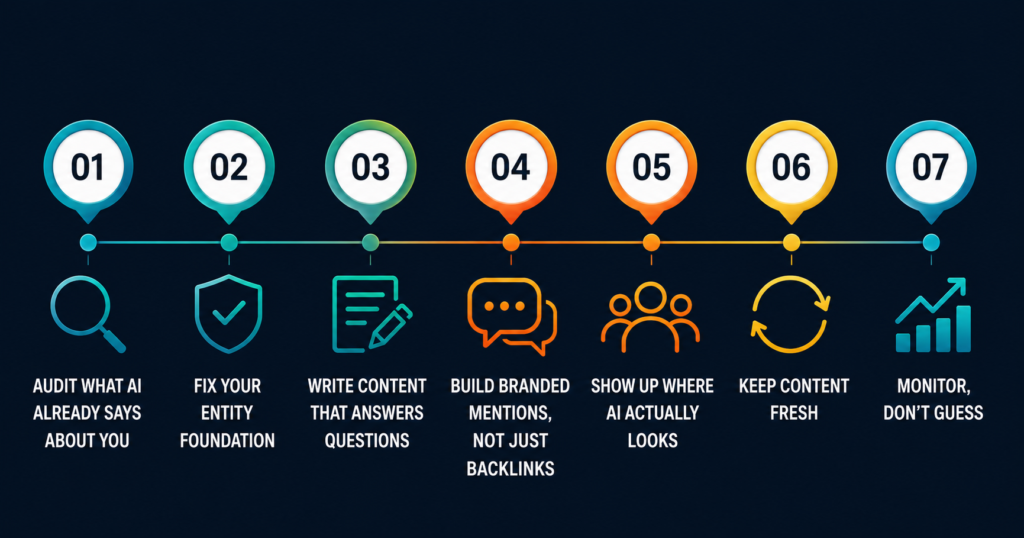
Getting your business recommended by AI is a repeatable process, not a lucky mention. Follow these steps in order, since each one builds the trust signal the next step depends on.
Step 1: Audit What AI Already Says About You
Before creating anything new, find out where you currently stand. Run 15–20 real customer questions through ChatGPT, Gemini, Claude, and Perplexity — the kind of questions your buyers actually ask, like “best [category] for [use case].” For each answer, note whether your brand appears, whether it’s cited with a link or just mentioned by name, and how it’s framed.
This baseline tells you whether your problem is visibility (you’re not showing up at all) or perception (you’re showing up but framed incorrectly or negatively).
Step 2: Fix Your Entity Foundation
Make sure your brand name, category, and value proposition are described identically across your homepage, About page, Google Business Profile, LinkedIn, and major directories. Inconsistent descriptions confuse the entity model AI systems build around your brand, and that confusion directly reduces AI search rankings.
Add Organization, Author, and sameAs schema markup so AI crawlers can connect your website to your other verified profiles. Structured data doesn’t guarantee a citation, but stackmatix’s 2026 schema analysis found pages with complete structured data are roughly 3.2 times more likely to appear in AI-generated summaries than pages without it.
Step 3: Write Content That Answers Questions Directly
Every page that targets a question your buyers ask should open with a direct, 2–4 sentence answer before going into supporting detail. This single formatting choice is one of the highest-leverage things you can do to improve AI recommendations, because it gives the model a clean, quotable claim it doesn’t have to reconstruct from scattered paragraphs.
Use FAQ sections with genuinely useful questions, not filler. FAQPage schema alone has been shown to lift AI citation rates by roughly 28–40%, according to AI Growth Agent’s structured data research — a meaningful gain for a relatively small implementation effort.
Step 4: Build Branded Mentions, Not Just Backlinks
Since branded mentions correlate with AI visibility far more strongly than backlinks, prioritize getting your name discussed in comparison articles, “best of” roundups, podcasts, and industry newsletters — even when they don’t link back to you. Digital PR, guest contributions, and expert commentary all compound here.
Step 5: Show Up Where AI Actually Looks — Reddit, YouTube, and Reviews
Contribute real, useful answers in relevant subreddits and niche forums where your category gets discussed. A detailed, honest answer written today can surface in an AI response months or years later — Discord and other closed chat platforms offer none of that compounding value because they’re not indexed. Publish explanatory YouTube content with clear titles, descriptions, and transcripts, since video citations are rising fast across AI platforms. And actively manage your reviews on Google, industry-specific platforms, and G2/Capterra-style sites if you’re B2B — AI models weigh review volume and recency as a trust signal.
Step 6: Keep Content Fresh
Ahrefs found that AI search platforms prefer to cite content that is roughly 25.7% fresher than the content that ranks in traditional organic results. Revisit and update your highest-value pages on a regular cadence rather than publishing once and moving on.
Step 7: Monitor, Don’t Guess
Re-run your baseline prompts monthly. Track which platforms mention you, how you’re framed, and which competitors are showing up instead. AI visibility platforms like Semrush Enterprise AIO can automate this tracking across ChatGPT, Gemini, and Perplexity if you want it at scale.
SEO vs. GEO vs. AEO: What’s the Difference
These three disciplines overlap but solve different problems, and confusing them is one of the most expensive mistakes a marketing team can make in 2026.
| Discipline | Goal | Where It Wins |
| SEO | Rank in a list of links | Google/Bing search results pages |
| AEO (Answer Engine Optimization) | Be the single best direct answer | Featured snippets, voice search, People Also Ask |
| GEO (Generative Engine Optimization) | Be cited or recommended inside a synthesized answer | ChatGPT, Gemini, Claude, Perplexity, AI Overviews |
SEO remains the foundation. Strong technical SEO, quality content, and credibility signals are exactly what AI systems draw on when deciding who to reference — you can’t skip SEO and expect GEO to work. But ranking #1 on Google no longer guarantees you’ll be named in an AI answer for the same query, which is why all three need dedicated attention.
Common Mistakes That Keep Brands Out of AI Answers
Most brands that struggle with AI search rankings are making one or more of these avoidable errors:
- Treating GEO as a content-only problem. Structured data, entity consistency, and off-site mentions matter as much as the words on the page.
- Chasing backlinks while ignoring mentions. As shown above, unlinked brand mentions correlate more strongly with AI visibility than backlinks do.
- Burying the answer. Long intros before the actual answer make content harder for AI systems to extract cleanly.
- Letting listings go stale. Wrong hours, old addresses, or outdated pricing get caught during the verification step most consumers now perform after seeing an AI recommendation.
- Ignoring Reddit and community platforms. Skipping these channels means missing a source AI engines cite in a large share of recommendation-style answers.
- Measuring only Google rankings. A page can rank #1 organically and still be completely absent from AI Overviews, ChatGPT, or Perplexity answers for the same query.
Best Practices to Improve AI Recommendations Long-Term
- Publish comparison and “best for X” style content honestly, including where you’re not the right fit — AI models favor content that reads as balanced and trustworthy over pure sales copy.
- Keep NAP (name, address, phone) and category information identical across every listing and directory.
- Use descriptive, keyword-informed headings instead of vague labels like “More Info,” since clear headings help AI map your content to the right query.
- Pair every major claim with a credible, named source rather than an unattributed statistic.
- Build genuine expertise signals — author bios, credentials, and case studies — since E-E-A-T applies to AI evaluation just as it does to traditional Google Quality Rater assessments.
Expert Tips for Faster Results
Prioritize the surfaces your buyers actually use. If you sell B2B software, Reddit threads and comparison articles likely matter more than a Google Business Profile. If you run a local service business, your Google Business Profile, review volume, and local citations matter more than a Reddit presence.
Don’t wait for perfect data before starting. GEO is still an open playing field — 54% of marketers say they now prioritize GEO or AEO, but only 12% report measurable results yet, according to a 2026 Fractl and Search Engine Land study. That gap is an opportunity for brands willing to move now rather than wait for a mature playbook.
How to Measure Your AI Search Rankings
Track three things monthly: mention rate (how often you appear in relevant AI answers), citation rate (how often that mention includes a link or clear attribution), and sentiment (how favorably you’re framed compared to competitors). Manual prompt testing across ChatGPT, Gemini, Claude, and Perplexity works for smaller brands; AI visibility platforms automate this at scale for larger ones.
Pair this with your existing analytics. Google Search Console and referral traffic reports can show AI-driven visits arriving from chat.openai.com, perplexity.ai, and Gemini, giving you a real conversion picture to weigh against visibility data.
Key Takeaways
- AI recommendations are the brand names AI tools mention directly when answering a user’s question — a stronger form of visibility than a standard search ranking.
- 62% of consumers trust AI for brand decisions, but most verify that recommendation elsewhere afterward, so consistency across the web matters as much as the initial mention.
- Branded mentions correlate with AI visibility more strongly than backlinks (0.664–0.709 vs. under 0.30, per Ahrefs).
- Direct, extractable answers, structured data, and fresh content all measurably increase AI citation rates.
- Reddit, YouTube, and review platforms are major sources for AI-generated recommendations — your GEO strategy needs to extend beyond your own website.
- SEO, AEO, and GEO work together; none of them replaces the others.
Conclusion
Getting your brand recommended by AI isn’t about gaming a new algorithm — it’s about becoming the kind of source that a careful, evidence-checking system can trust and quote with confidence. That means clear entity signals, direct answers, consistent information everywhere your buyers look, and a genuine presence in the communities where your category gets discussed.
The brands winning AI recommendations right now aren’t necessarily the biggest ones. They’re the ones structuring their content and their reputation to be verifiable — and starting today, while most competitors are still treating this as optional.
Ready to turn AI search into a real growth channel for your business? Book a free business growth consultation with our team at MinchowCoders and we’ll show you exactly where your brand stands in AI recommendations today — and what to fix first.
More insights
AI Agents in 2026: What They Are, How They Work, and How Businesses Can Use Them
A chatbot can answer a customer’s question. An automation can move information from one application to another. An AI…
GPT-6 Astra AGI: Is This OpenAI’s AGI Era Moment
OpenAI did something no major AI lab had done before in such blunt terms: it stood in front of…
The Lean Startup Summary: The Complete Breakdown Every Founder Needs
The Lean Startup by Eric Ries teaches entrepreneurs to test business ideas with a Minimum Viable Product instead of writing a long business plan. The lean startup methodology uses a Build-Measure-Learn loop to validate what customers actually want, so founders…
Want results like this for your business?
Book a free consultation and we will show you where to start.
Talk to us on WhatsApp