Table of Contents
Good to Great Summary: The Framework Behind Jim Collins’ Bestselling Book
Most business owners have heard someone quote “good is the enemy of great” at a conference and nod along without really knowing where it came from. It comes from this book. And once you understand the research behind that line, it changes how you think about growth.
This Good to Great summary breaks down every core idea from Jim Collins’ research, in plain language, without the fluff.
What Is Good to Great Summary About
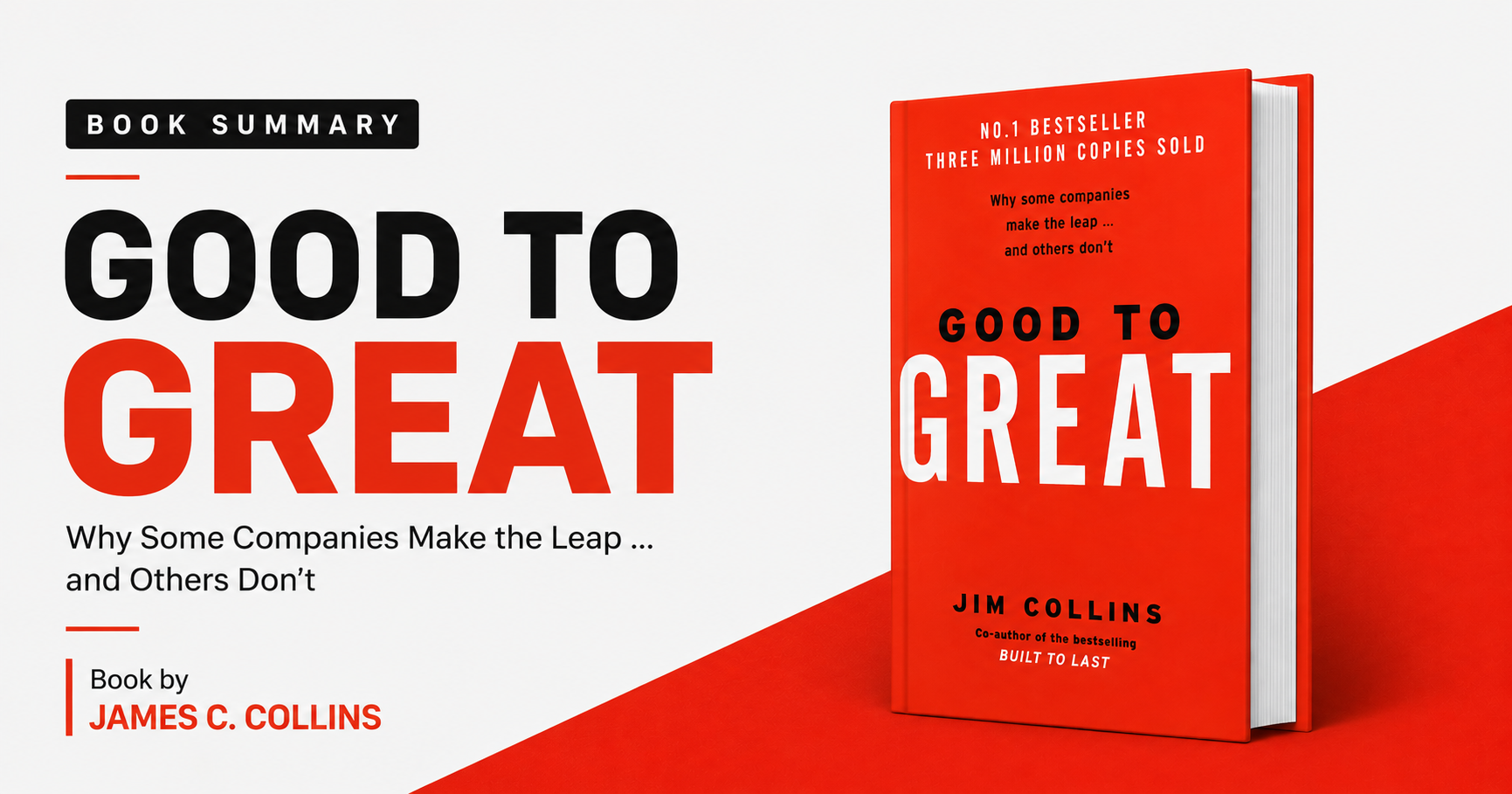
Good to Great: Why Some Companies Make the Leap… and Others Don’t is a 2001 business book by Jim Collins. It’s based on a five-year research project that studied 1,435 companies to find out why a small group made the leap from average performance to sustained, exceptional results. The answer wasn’t luck, charisma, or technology. It came down to disciplined people, disciplined thought, and disciplined action.
Book Overview of Good to Great
Jim Collins and his research team set out to answer one question: can a good company become a great one, and if so, how? They screened 1,435 companies and found just 11 that made a genuine leap — meaning they beat the general stock market by at least three times over 15 years, after years of only average performance.
The book matters because it wasn’t built on opinion. It was built on data: financial analysis covering 980 combined years of company history, 84 executive interviews, and a comparison against companies that had the same opportunities but failed to capitalize on them. That comparison is what makes the Good to Great summary so useful. It’s not just a list of what great companies did. It’s a picture of what mediocre companies did instead.
Published by HarperBusiness in October 2001, the book went on to sell more than four million copies and is still referenced in business schools, leadership training, and strategy meetings today.
Author Overview
Jim Collins built his career studying what separates enduring, high-performing organizations from the rest. Before writing Good to Great, he left a teaching and research position at Stanford to become an independent researcher based in Colorado. His earlier book, Built to Last, looked at how visionary companies are built from the ground up. Good to Great picked up where that book left off, focused on how an already-established, merely “good” company can become genuinely great.
Core Ideas Explained about Good to Great
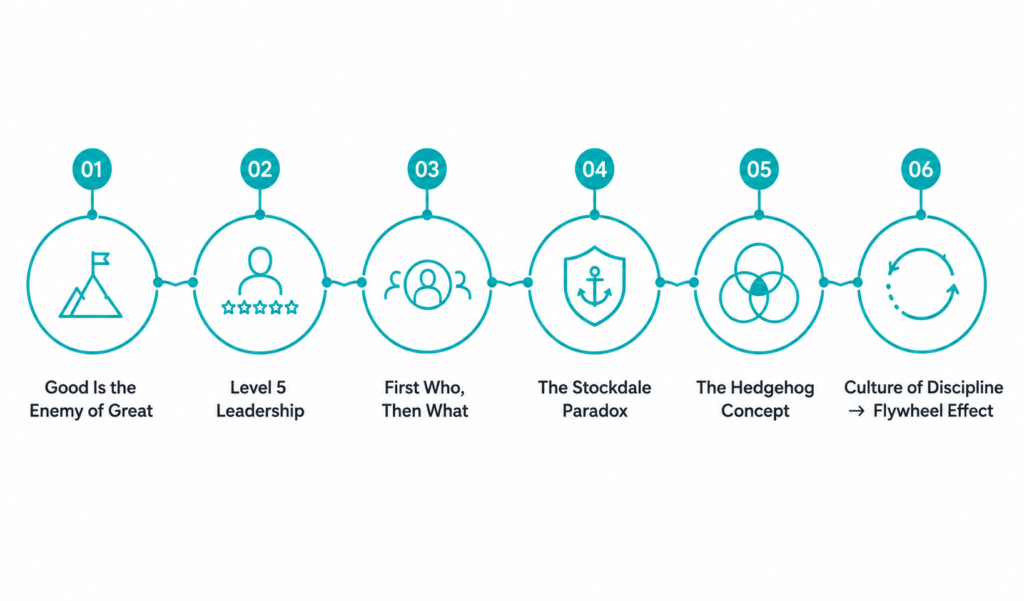
Good Is the Enemy of Great
This is the book’s central argument. Most companies never become great, not because they fail, but because they succeed just enough to stop pushing. A comfortable, “good enough” business rarely feels urgent about change. Collins found that the companies which made the leap treated their current success as a starting point, not a finish line.
For a business owner, this idea applies directly. If your business is doing fine, “fine” can quietly become the ceiling. Growth usually stalls the moment a team decides good performance is good enough.
Level 5 Leadership
Collins found that every good-to-great company was led during its transition by what he calls a Level 5 Leader. These leaders combine two traits that don’t usually go together: deep personal humility and intense professional will.
They’re rarely the loud, charismatic executives who get magazine covers. Instead, they credit the team and outside factors when things go well, and take personal responsibility when things go wrong. Their ambition is aimed at the company’s success, not their own reputation.
This matters for smaller businesses too. Founders who build a lasting company tend to focus on the mission, not on personal recognition.
First Who, Then What
Most leaders think strategy first, people second. Collins found the opposite was true of great companies. They got the right people in place before deciding on direction.
The logic is simple: if you have the right people, they’ll help you figure out the best direction, and they’ll adapt when the market changes. If you have the wrong people, the best strategy in the world won’t save you. This is where the well-known “get the right people on the bus” idea comes from.
The Stockdale Paradox
Named after Admiral James Stockdale, a prisoner of war for seven years during the Vietnam War, this concept sits at the center of Chapter 4. It means holding two things at once: unwavering faith that you’ll succeed in the end, combined with a brutally honest look at your current, difficult reality.
Businesses that avoid facing hard truths, whether it’s declining sales, a failing product line, or a bad hire, tend to drift. The companies that made the leap did the opposite. They confronted the facts directly, without losing belief that they’d figure it out.
The Hedgehog Concept
This is one of the most practical frameworks in the book. Collins asks you to picture three overlapping circles:
- What you can be the best in the world at
- What drives your economic engine (profit or cash flow per unit)
- What your people are genuinely passionate about
Where all three overlap is your Hedgehog Concept. It took the good-to-great companies an average of four years to work this out. It’s not a slogan. It’s a clear-eyed understanding of where your business actually has an edge, and that clarity is what let them say no to distractions.
A Culture of Discipline
Once a company understands its Hedgehog Concept, the next job is to build a culture where people don’t need constant supervision to stay within it. Collins contrasts a “culture of discipline” with a bureaucratic one. Bureaucracy exists to manage people who lack discipline. A disciplined culture removes the need for most of that structure altogether.
The Flywheel Effect (vs. Doom Loop)
This might be the most useful metaphor in the whole book. Picture a massive, heavy flywheel. Getting it moving takes enormous, sustained effort at first. But each push builds on the last, and eventually the wheel’s own momentum starts carrying it forward faster than you’re pushing.
That’s the Flywheel Effect: consistent, unglamorous effort, applied in the same direction over time, that eventually compounds into something that looks dramatic from the outside.
The opposite is the Doom Loop. Companies fall into it when they chase a new program, a new leader, or a new direction every time results disappoint. Instead of building momentum, they reset it, over and over, and never gain speed.
Chapter-Wise Summary
Chapter 1 – Good Is the Enemy of Great: Introduces the book’s central thesis and the research project behind it.
Chapter 2 – Level 5 Leadership: Defines the humble-but-driven leadership style found in every good-to-great company.
Chapter 3 – First Who, Then What: Explains why getting the right people in place comes before deciding on strategy.
Chapter 4 – Confront the Brutal Facts (Yet Never Lose Faith): Introduces the Stockdale Paradox and the importance of honest self-assessment.
Chapter 5 – The Hedgehog Concept: Lays out the three-circle framework for finding your company’s real competitive edge.
Chapter 6 – A Culture of Discipline: Covers how disciplined people and disciplined thought lead to disciplined action, without heavy-handed management.
Chapter 7 – Technology Accelerators: Argues that technology speeds up momentum that already exists, but it isn’t the source of that momentum.
Chapter 8 – The Flywheel and the Doom Loop: Explains how sustained, consistent effort compounds into big results, and why constant pivoting prevents that from happening.
Chapter 9 – From Good to Great to Built to Last: Connects the good-to-great research back to Collins’ earlier work on what makes companies endure over generations.
Good to Great Summary Key Takeaways
- Comfort with “good” performance is usually what blocks a business from reaching “great.”
- The best leaders are humble about themselves and demanding about results.
- People decisions come before strategy decisions, not after.
- Clarity about where you can genuinely be the best beats chasing every opportunity.
- Momentum builds slowly, through consistent effort, not through one big announcement.
- Facing hard truths early prevents bigger problems later.
Actionable Takeaways
- Write down your Hedgehog Concept. Identify what you’re genuinely best at, what actually drives your revenue, and what your team cares about. If you can’t find the overlap yet, that’s useful information too.
- Audit your team before your strategy. Before setting new goals, ask honestly whether you have the right people in the right roles.
- Create a “stop doing” list. Alongside your to-do list, write down what you’ll deliberately stop spending time on.
- Look for your flywheel. Identify the one or two consistent actions that, done repeatedly, would build real momentum in your business, and commit to them longer than feels comfortable.
- Practice the Stockdale Paradox. Once a quarter, sit down and honestly list what isn’t working, without losing sight of your long-term direction.
Who Should Read This Book
This book is genuinely useful for founders, small business owners, marketing managers, and agency owners who are trying to move a business from steady to exceptional. If you’re a local business owner wondering why a competitor with a similar offer keeps growing faster than you, the Hedgehog Concept and Flywheel Effect chapters are worth reading closely.
It’s also relevant for anyone leading a team, even a small one. The Level 5 Leadership and First Who, Then What sections apply just as much to a five-person team as they do to a Fortune 500 company. At Minchow Coders, we see the same pattern play out in local business growth: businesses that get clear on their niche and stay consistent with it tend to outperform ones chasing every trend in local search and AI visibility.
Limitations
No summary of this book would be complete, or honest, without mentioning its criticism. Economist Steven D. Levitt pointed out that several of the “great” companies featured in the book later ran into serious trouble, including Circuit City and Fannie Mae, and that investing in the full portfolio of 11 companies from 2001 onward would have actually underperformed the S&P 500.
Researcher Phil Rosenzweig also raised methodological concerns, arguing the book relied heavily on magazine articles that can carry a “halo effect” bias, and that some of its conclusions confuse correlation with causation rather than proving a clear cause-and-effect relationship.
These criticisms don’t erase the value of the frameworks. But they’re a fair reminder that past performance, even 15 years of it, doesn’t guarantee future results.
Final Verdict
This Good to Great summary only scratches the surface of what’s in the full book. The research, the company-by-company comparisons, and the original data are worth reading firsthand if you want the complete picture, not just the frameworks. Any honest Jim Collins Good to Great review has to acknowledge that the ideas are simple to state but genuinely hard to apply consistently, which is exactly the point Collins makes himself.
If you run a business and you’re serious about long-term growth, this book belongs on your shelf, not just your reading list.
Ready to Build Your Own Flywheel
Finding your Hedgehog Concept in your business is one thing. Making sure customers can actually find you while you build it is another. If you’re a local business owner working on long-term growth, our team at Minchow Coders can help you get visible across Google Search, Google Maps, and AI-powered search tools like ChatGPT and AI Overviews. Book a free growth consultation with Minchow Coders and we’ll show you where your visibility gaps actually are.
More insights

AI Agents in 2026: What They Are, How They Work, and How Businesses Can Use Them
A chatbot can answer a customer’s question. An automation can move information from one application to another. An AI…

GPT-6 Astra AGI: Is This OpenAI’s AGI Era Moment
OpenAI did something no major AI lab had done before in such blunt terms: it stood in front of…
The Lean Startup Summary: The Complete Breakdown Every Founder Needs
The Lean Startup by Eric Ries teaches entrepreneurs to test business ideas with a Minimum Viable Product instead of writing a long business plan. The lean startup methodology uses a Build-Measure-Learn loop to validate what customers actually want, so founders…
Want results like this for your business?
Book a free consultation and we will show you where to start.
Talk to us on WhatsApp